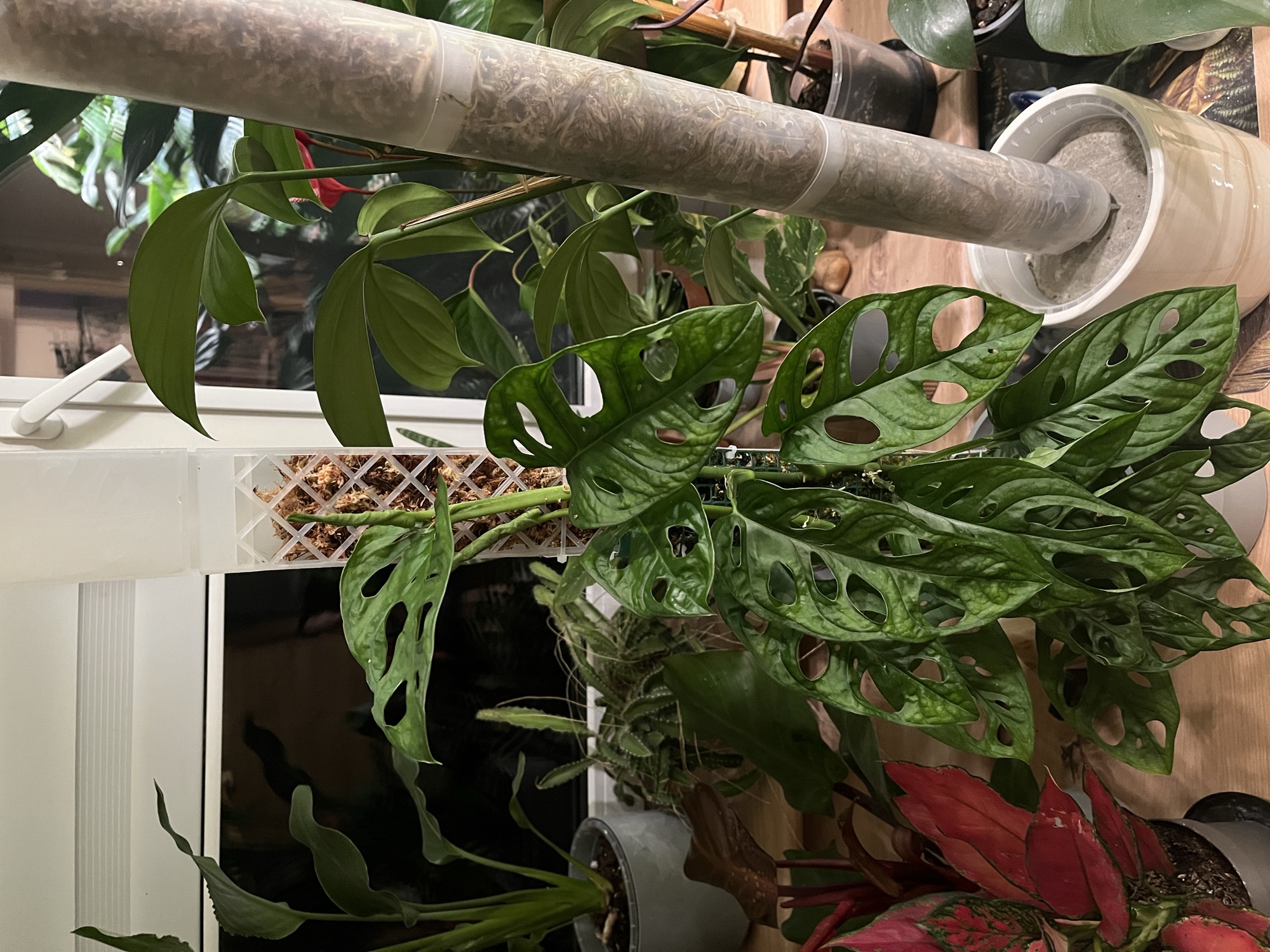
Monstera adansonii on a Moist Moss Pole: Shorter Internodes and Extending the Pole Without Tearing Roots
From a dry wooden plank to a moss pole, then a DIY + Sphagrow hybrid. What changed, and how to extend a pole without pulling roots out of the moss.
- Acc.
- 0010
- Species
- Monstera adansonii
- Fam.
- Araceae
- Coll.
- M. Kuliberda,
- Tags
- moss-pole / monstera
TL;DR
- On a dry wooden plank, Monstera adansonii grew fast but looked wild: leaves around 15 cm, internodes around 7 cm.
- After moving to a moist moss pole, internodes shortened to about 5 cm and leaves grew to about 17 × 9.5 cm.
- You can extend a moss pole without pulling roots out of the moss: remove only the back panel, keep the mesh, and click a ready-made segment in on top.
- Don’t bury the moss in the substrate. Fill the buried part of the pole with aroid mix instead.
Fussy?
Monstera adansonii, the monkey mask, has a reputation online for being fussy, and my first attempt seemed to confirm it. My first plant was very sensitive to placement. I found only one spot in the room where it grew well, and moving it 0.5 m either way made some of the leaves turn yellow.
It was also very sensitive to excess water in the substrate. With a poor mix and limited light, that ended in root rot. Then thrips arrived, and the first plant had to go. My impression is that its delicate leaves don’t hold up long under a pest attack. I wrote more about fighting thrips in my pest notes.
In The Bitter Truth of Growing Tropical Plants I listed adansonii among the plants that grow well for me without much effort. Those two things don’t contradict each other: once I know what it needs, it stops being fussy.
A second plant on a dry plank
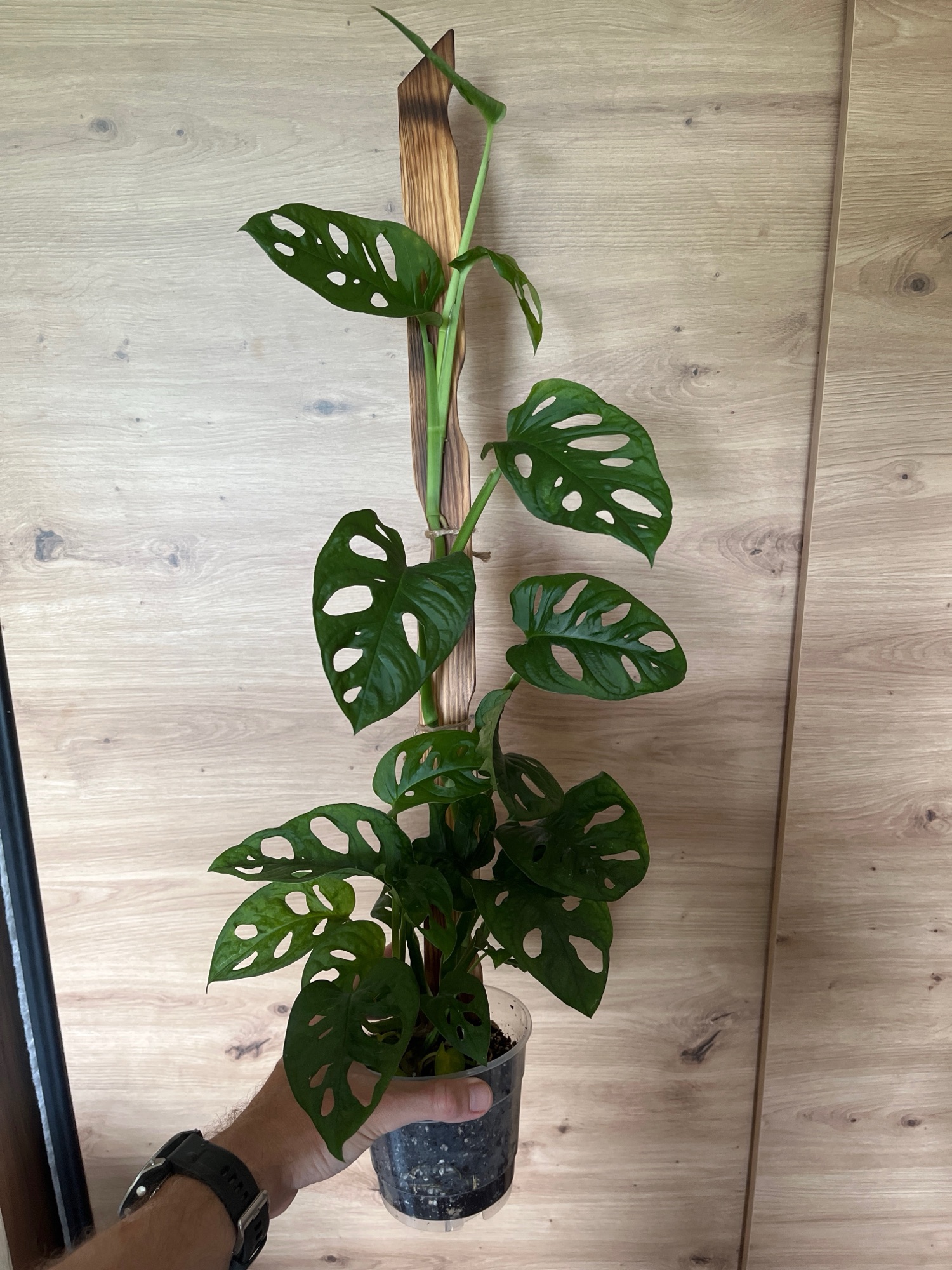
Some time later I saw a young but sturdy plant in a DIY store and decided to try again. This time I already knew where it got the best light (not too much, not too little) and that it needs a loose substrate. It grew in roughly 50% Plagron Lightmix with perlite and coir. It also got a dry wooden support, which it climbed bravely.
And it did grow well, and fast, unlike my deliciosa. New leaves kept coming, which is a very rewarding sight.
But leaf size stalled at about 15 cm long, and the internodes were fairly long, around 7 cm. The plant was growing, but it looked wild.
The cut and a moist DIY pole
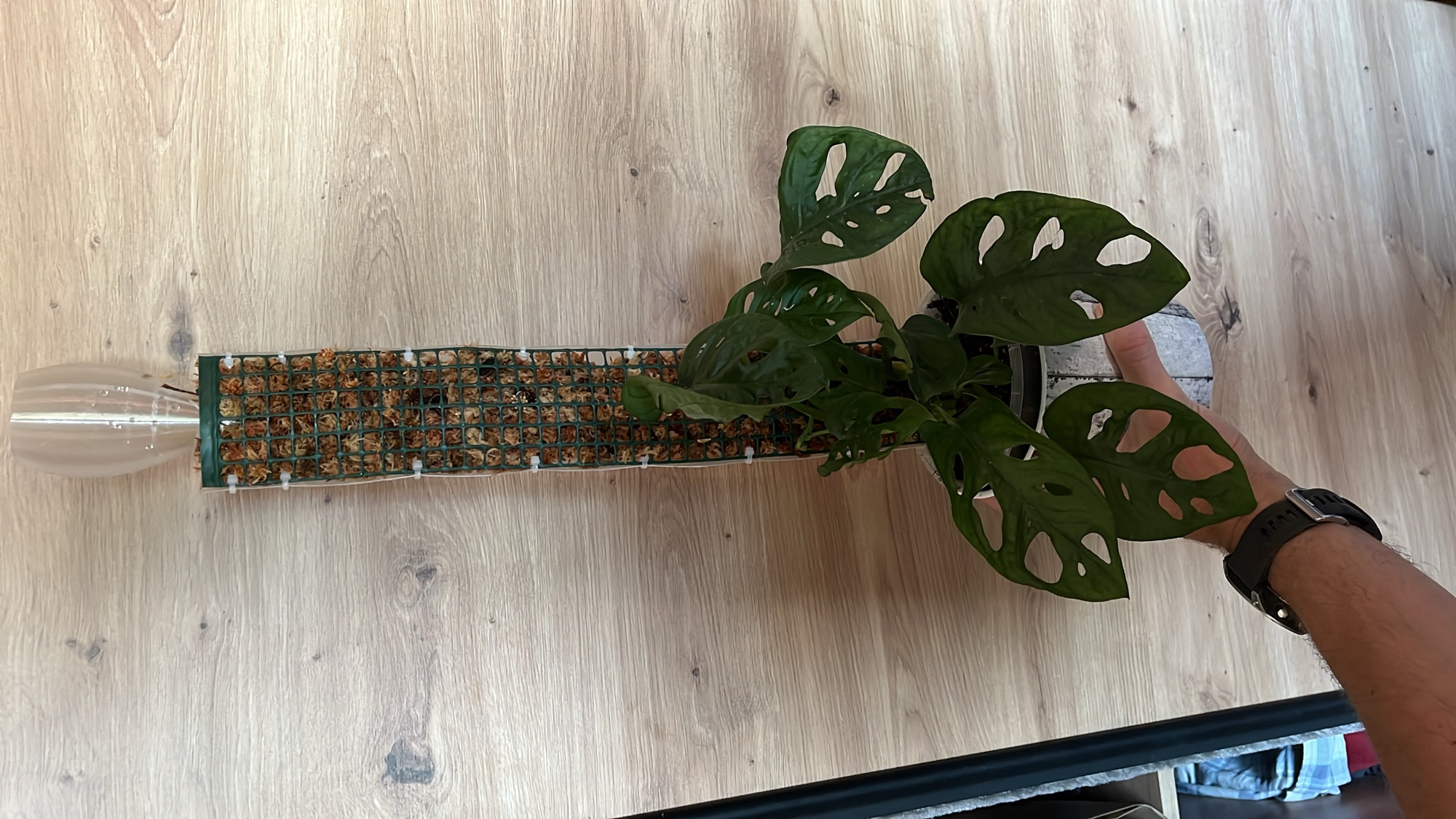
When it reached the end of the plank, I decided to risk a moist moss pole. On 28 July 2026 I cut it in half, and two parts went into a new pot with the pole: the bottom part and the cut-off top. Since then it has grown as two stems.
I built the pole myself:
- the front is PVC mesh with 10 mm openings,
- the back panel is cut from an office chair mat,
- the filling is pure sphagnum,
- on top sits a ready-made dripper that narrows towards the bottom, plugged with a tuft of moss to slow the water down.
The bottom of the pole was buried, but filled with the same mix as the pot rather than with moss (more on why below).
The substrate changed too, to a much looser one: 5–15 mm pine bark, coco chips, coir, Lechuza PON and only about 10–15% Plagron Lightmix.
I feed carefully so the moss doesn’t build up salts. At first, before roots had colonised the pole, I watered the substrate regularly with a slightly stronger solution, EC 800–900 µS/cm. Now I water the substrate only lightly, and the pole gets 600–700 µS/cm of a hydro fertiliser, currently Plagron Hydro A+B.
What changed
The moist pole clearly suited it. The plant stayed in the same spot as before, and the new leaves and internodes looked like this:
| Dry plank | Moist pole | |
|---|---|---|
| Leaf length | about 15 cm | about 17 cm (9.5 cm wide) |
| Internode | about 7 cm | about 5 cm |
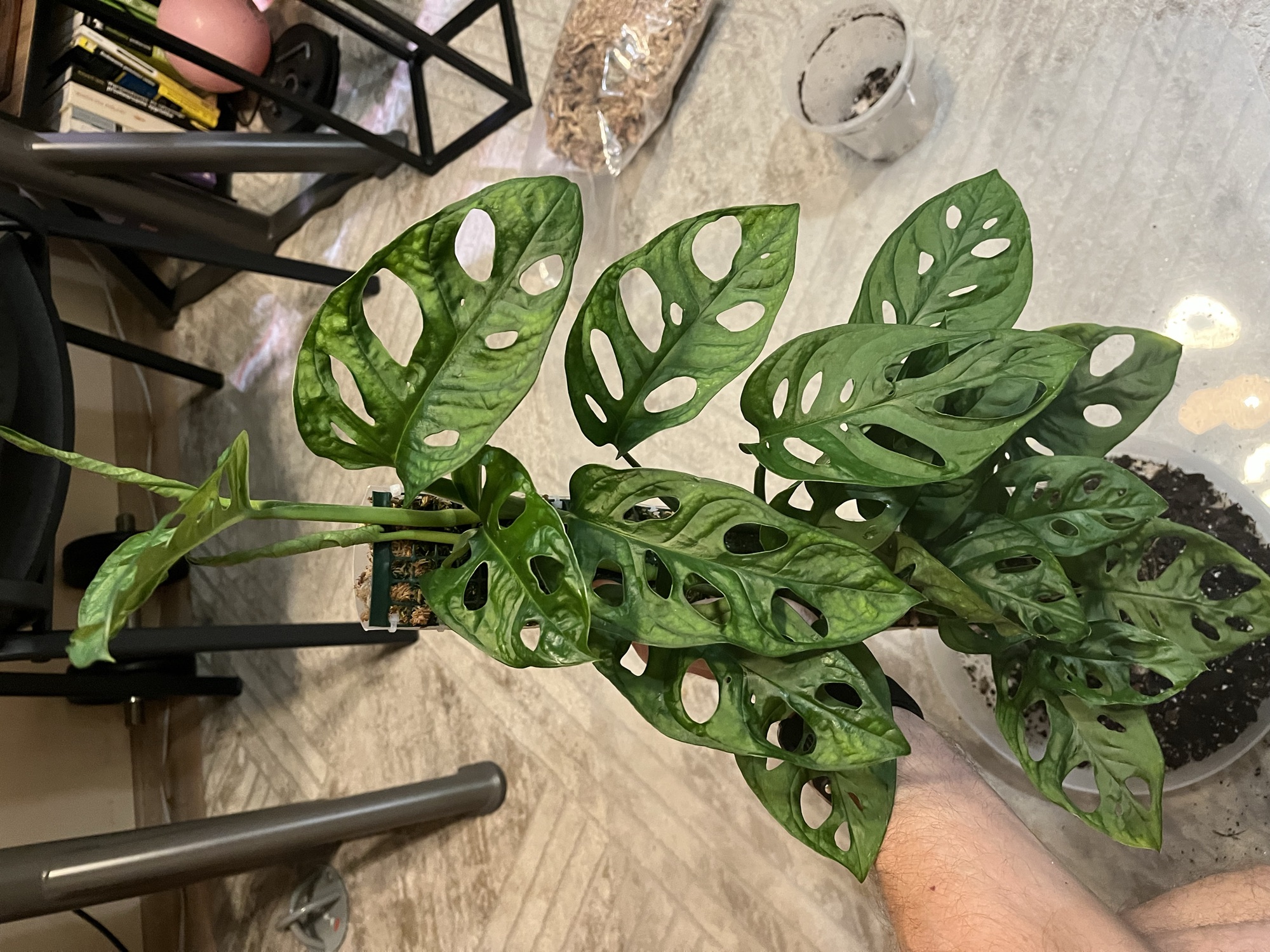
The newest leaf has 6 large fenestrations and 3 tiny ones closer to the midrib. Since there have been two stems, a new leaf appears every few days, though “few” is stretched to its upper limit here.
To be fair, the pole wasn’t the only change. At the same moment the plant was cut back and got a new, much looser substrate. It seems to me the pole made the biggest difference, but I can’t separate the effects.
The leaves got bigger, but not as much as I’d hoped. So less than a month ago, as an experiment, I moved it closer to the window, on the assumption that this plant might be a bit different from the previous one. It used to stand about 90 cm off to the side of a south-facing window. Now it stands 70 cm directly in front of it, with no grow light. It took that well, and the leaves show no signs of light stress. Humidity by the window is around 60%, and the temperature stays a little above 20 °C, reaching 27–28 °C during the day.
I left it there and kept feeding it like my other aroids on moss poles. It reached the top of the pole fairly quickly.
Why are the leaves still small?
17 cm is still small, and I see two possible explanations.
The first is the growth stage. Monsteras have a juvenile and an adult form, and the leaves get noticeably bigger and more perforated only as the plant climbs. Stems that stop climbing revert to the juvenile form. Growers also note that indoors even a moist pole often doesn’t bring the plant to its full adult form.
The second is genetics. Maybe I bought a form that simply has smaller leaves and is already hitting its ceiling. Plants sold as Monstera adansonii are often M. adansonii subsp. laniata (formerly var. laniata). But adult leaves of that subspecies reach 22–55 cm in the wild, so the taxon itself probably doesn’t cap them at 17 cm. I don’t know exactly what I have, though, so for now it’s an open question.
Extending the pole: a DIY + Sphagrow hybrid
It was time to extend the pole. At the same time I decided to switch from DIY to the widely available Sphagrow pole with a dripper. It’s stiffer, has the dripper, and it’s very easy to extend, because you just click in a new segment. Cutting the plant is simple too: you cut at the boundary between segments and put the chosen number of top segments, plant included, into a new pot.
The problem was that the old pole was already densely rooted, and I didn’t want to tear those roots. It’s a fussy plant, after all ;). I did the whole extension on 30 October 2026, like this:
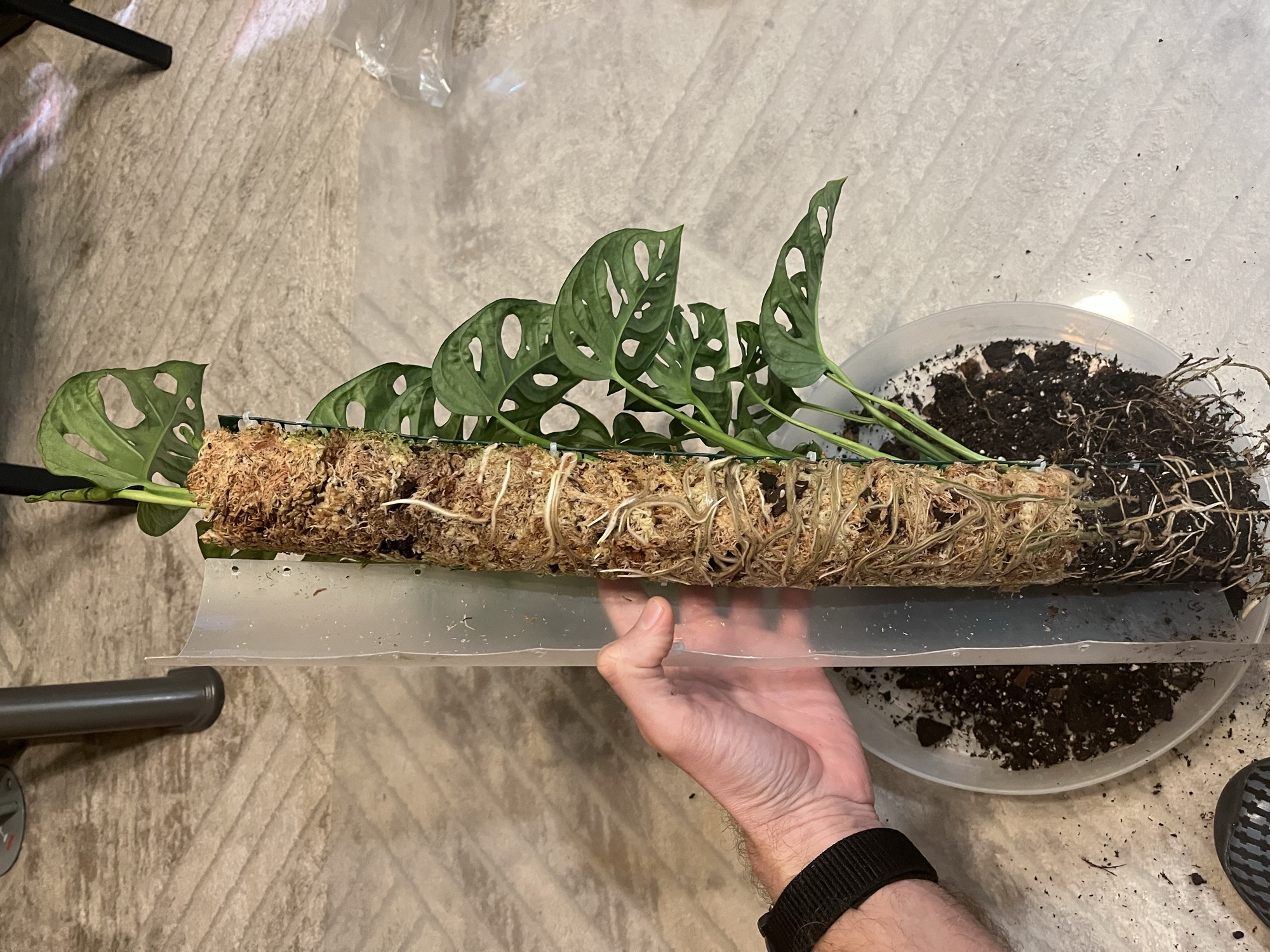
- I removed the old back panel but kept the mesh, so the roots grown into the moss stayed undisturbed.
- I made a new, wider back panel so the cross-section of the old pole matched the Sphagrow segment.
- I joined the new back panel to the mesh.
- I pushed a Sphagrow segment (23 cm) into the top of the pole and tightened everything with cable ties.
- This time I filled the segment and the spare space in the old pole with a mix of sphagnum and coco chips, roughly 2:1.
My impression is that this mix works better and is less prone to the moss rotting, which I’ve experienced before and don’t recommend.
Don’t bury the moss
When you pot a plant onto a moss pole, remember not to bury the moss in the substrate. I did it once, with a different plant, and I don’t recommend it. Buried sphagnum wicks water up from the substrate and stays permanently soaked, runs out of oxygen, and soon starts to rot.
So I fill the buried part of the pole with aroid mix. Ideally, the aroid mix inside the pole reaches a few centimetres above the substrate surface.
What’s next
If the monstera keeps up its fast, trouble-free growth, I plan to add two more segments. Then it will be time to cut it and keep growing only the part on the ready-made segments.
The only risk I can see is that over time the monkey mask makes so many roots that this type of pole starts to restrict it. For now I’m not worrying in advance, especially since it doesn’t seem as expansive with its roots as its big sister, the deliciosa.
Sources
- CATE Araceae: Monstera adansonii subsp. laniata: adult leaf dimensions.
- ColPlanta: Monstera adansonii subsp. laniata: naming and synonyms.
- Aroidpedia: Monstera morphology: juvenile and adult forms.
- Top Tropicals: juvenile and adult monstera: growers’ observations.